Dioscorides' Plants, Then and Now
θύμος

Conehead thyme

Thymbra capitata (L.) Cav. · Lamiaceae
Identification: ProbableNot endemic to GreeceConservation status not assessed
Risk rank
24 of 32 (20–27)
Risk score
0.28(0.28–0.28)2 · Moderate

Then and now

2050 · moderate emissions. SSP2-4.5, 2041-2060, 3 climate models; ranges show the spread.

The plant
θύμος
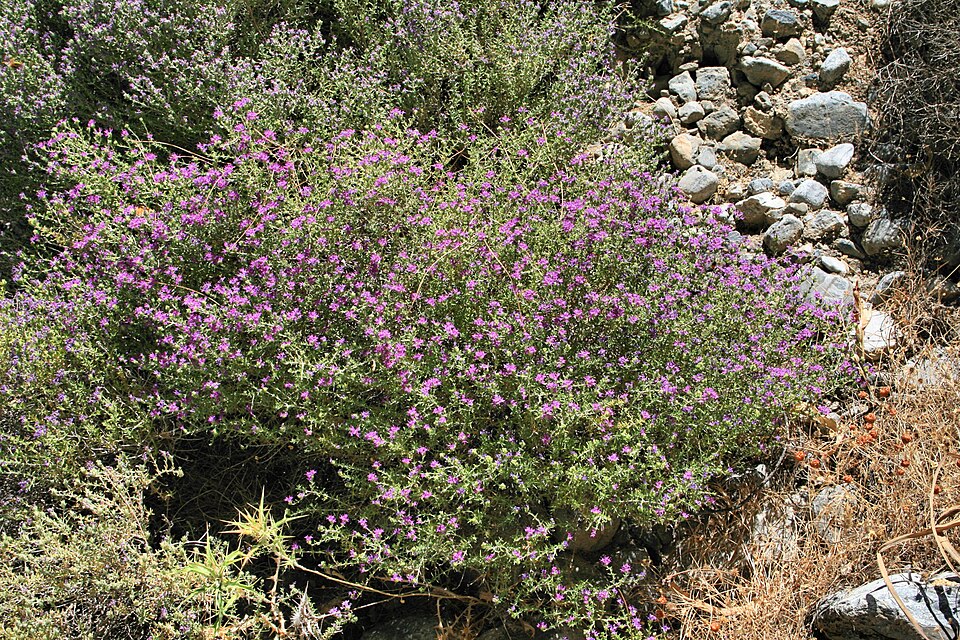
Photograph of Thymbra capitata
Photo: Lapplaender · CC BY-SA 3.0 de · Wikimedia Commons (photo of Conehead thyme)
2050 · moderate emissions
Natural Earth (PD) · model output · ~10 km cells
Loading map layers (0 of 1)
Layers
Range keptLost by 2050Gained by 2050Cultivation zoneNatura 2000Occurrence cellCells ≈ 10 × 10 km

Occurrences are aggregated to ~10 km cells; exact points are never published. View range data as a table

De Materia Medica · Book III · ch. 36c. 50–70 CE
θύμος
thymos
θύμος· γινώσκεται ὑπὸ πάντων. θαμνίσκιον φρυγανοειδές, φυλλαρίοις στενοῖς καὶ πολλοῖς περιειλημμένον, ἔχον ἐπ᾿ ἄκρου κεφάλια ἄνθους ⟨περίπλεα⟩, πορφυρίζοντα. …
Modern identification
Thymbra capitata(L.) Cav. · LamiaceaeProbable

Source: Sprengel 1830, vol. 2, pp. 511-512; Fraas 1845, p. 174; Osbaldeston 2000.

Full citation and quoted evidence

Sprengel 1830, vol. 2, pp. 511-512 (Comm. III cap. XXXVIII): 'Thymum Dioscoridis legitimum, quem Brunfelsius, Tragus ac Fuchsius pro Thymo vulgari habuerant, Matthiolus primus in Thymo cretico Brot. (Satureia capitata L.) recognovisse videtur'; describes the plant, abundant on Hymettus. Satureia capitata L. is the basionym-era name of Thymbra capitata. 'probable' because Sprengel records the earlier rival identification (Thymus vulgaris) and says 'videtur'. Fraas 1845, p. 174: 'Sat. capitata L., Satureystrauch' = θύμος Hippocr., λευκὸς θύμος Theophr. 6,1,2, θύμος Diosc. 3,38; modern θυμάρι 'frequentiss. appellatio'; very common scrub on dry plains, hills and foothills to 2500 ft throughout. Osbaldeston 2000, ch. 3-44 THUMOS: SUGGESTED Thymus angustifolius, Thymus glaber (Wild Thyme) - a competing candidate. (https://archive.org/details/BIUSante_dioscsprengelx02/page/n512/mode/1up ; https://archive.org/details/synopsisplantaru00fraa/page/n219/mode/1up)

Opening words of the chapter (Wellmann numbering). Edition: Wellmann 1906, Pedanii Dioscuridis Anazarbei De materia medica vol. II (libri III-IV), Berlin: Weidmann; read from page scan on archive.org (BIUSante_65865x02), p. 48 (⟨περίπλεα⟩ is Wellmann's supplement). See the page scan.

No European Medicines Agency herbal monograph for this species.

Projected range change by 2050

2050 · moderate (SSP2-4.5)+8% (+3 to +9%)
2050 · high (SSP5-8.5)+19% (+13 to +27%)

Median and spread across 3 climate models. Whisker axis −80% to +20%, dashed tick at 0; a chevron means the value runs beyond the axis.

Suitable cultivation area, 2050 moderate971 km² (670–1,270 km²)

Risk score breakdown

0.28 (0.28–0.28)Moderate risk class 2
00.51.0
  • Range loss 0.00 of max 0.40 · (0.00–0.00)
  • Endemism 0.00 of max 0.20 · not endemic
  • Conservation status 0.10 of max 0.20 · not assessed
  • Harvest pressure 0.18 of max 0.20

Stays in the top 10 in 0% of 1,000 random weightings.

How the score is built, and how sensitive it is to weights

Model quality

Standard grade
AUC (spatial block CV)
0.85 ± 0.02
Distance-only baseline AUC
0.78 ours is higher
Boyce index
0.95 ± 0.03
TSS
0.57 ± 0.04
Occurrence records
1,291 after cleaning (of 1,980)

5-fold spatial block cross-validation (~25 km blocks); ± is one standard deviation across folds. Null model AUC 0.50. The baseline scores each held-out point by its distance to the nearest training record, on the same folds. "Standard" grade means ≥ 30 records, AUC ≥ 0.75 and above the baseline; fewer than 10 records is a data gap; anything else is low grade.

Suggested action

Cultivation opportunity

Climate-resilient candidate crop; cultivation can take pressure off wild collection.

Rule: Gains or keeps habitat · has a 2050 cultivation zone.

Where it could be grown

Identification through time

Who has matched θύμος to which modern plant, from the Renaissance to today.

All names through time
Cited for the identification we modelProposed an alternativeAlternative preferred by our sourceAlternative rejected by our sourceCommonly proposed, not verified by us
Renaissance commentators
Linnaean botany & Flora Graeca
Edition
Modern
150016001700180019002000

Select a mark to read who proposed which plant, and the source we read it in.

Dates are each authority's main herbal or commentary (approximate, "c."), used to order the timeline. Claims are parsed from our curated identification table; every quote links back to a page scan or edition on the plant page.

Caveats

  • Identification is probable; results describe Thymbra capitata (L.) Cav., which may not be the plant Dioscorides meant.

Range data (map alternative)

ScenarioSuitable ~10 km cellsChangeShare in Natura 2000
Now765—20.9%
2050 moderate760 (717–773)+8% (+3 to +9%)23% (23–23%)
2050 high830 (766–872)+19% (+13 to +27%)24% (23–24%)