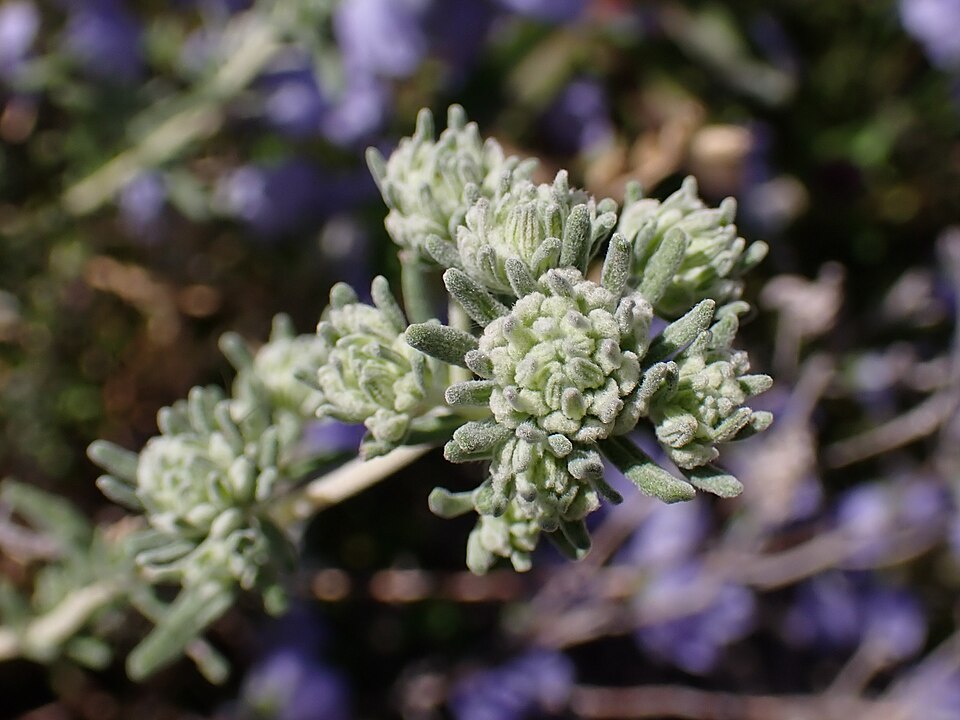

πόλιον· τὸ μέν ἐστιν ὀρεινόν, ὃ καὶ τεύθριον καλεῖται, οὗ καὶ ἡ χρῆσις. θαμνίον δέ ἐστι λευκόν, λεπτόφυλλον, σπιθαμιαῖον, καρποῦ πλῆρες …Greek records of 'T. polium' refer to T. capitatum (Dimopoulos et al. 2013), so both names are pooled. Source: Sprengel 1830, vol. 2, p. 544; Fraas 1845, p. 173; Osbaldeston 2000.
Full citation and quoted evidence
Sprengel 1830, vol. 2, p. 544 (Comm. III cap. CXIV): 'Teucrium Polium πολίου nomine intelligi, in confesso est, Matthiolo, ni fallor, id primo probante.' The second, more shrubby and less strong-smelling kind is disputed: Matthiolus Teucrium montanum (rejected), Sprengel 'Teucrium potius creticum L., s. rosmarinifolium Lam.' Note: Sprengel's 'Teucrium polium' is the broad Linnaean sense; the Greek populations are now T. capitatum L. (nomenclatural mapping is ours, not Sprengel's). 'certain' applies to the first (mountain) kind only. Fraas 1845, p. 173: 'T. Polium L., grauer Gamander. Ist wohlriechend!' = πόλιον Hippocr., Theophr. 1,16, Diosc. 3,114; 'T. capitatum. Ist höher und riecht nicht.' = πόλιον τὸ θαμνωδέστερον καὶ ἀδρανέστερον Diosc. l.c. (i.e. Fraas names T. capitatum for Dioscorides' SECOND, shrubbier, weaker kind); both common on dry plains and hills to 3000 ft (p. 173-174). Osbaldeston 2000, ch. 3-124 POLION: SUGGESTED Teucrium polium. (https://archive.org/details/BIUSante_dioscsprengelx02/page/n545/mode/1up ; https://archive.org/details/synopsisplantaru00fraa/page/n218/mode/1up)
Opening words of the chapter (Wellmann numbering). Edition: Wellmann, Pedanii Dioscuridis Anazarbei De materia medica, vol. II (Berlin 1906), p. 121; read off the archive.org page image (item b21459162_0002) and cross-checked against two OCR layers; ϑ printed as θ. See the page scan.