Dioscorides' Plants, Then and Now
ἐλελίσφακον

Greek sage

Salvia fruticosa Mill. · Lamiaceae
Identification: DisputedNot endemic to GreeceConservation status not assessed
Risk rank
22 of 32 (18–24)
Risk score
0.29(0.29–0.29)2 · Moderate
Identification disputed. Scholars propose more than one modern species. We model the most cited candidate and show the alternative for comparison. Rankings are also reported without disputed plants on the Methods page. See how its rank changes under each alternative identification.
Modelled
Salvia fruticosa
Sprengel 1830, vol. 2, p. 510 (Comm. III cap. XXXV, ἐλελίσφακον): 'Quaenam salviae species intelligatur, potest omnino ambigi. Vero tamen est haud absimile, Salviam nostram officinalem, quae in asperis omnis Graeciae locis provenit, hac appellatione comprehendi.' Sprengel names Salvia officinalis (tentatively), NOT S. fruticosa; the species is explicitly said to be open to doubt. | Fraas 1845, p. 184: '20. Salvia pomifera L., breitblättriger Salbey (triloba und baccifera sind synonym). Ist die bei weitem häufigste in Griechenland' = σφάκος Theophr., ἐλελίσφακον Diosc. 3,35; also S. calycina L. = ἐλελίσφακον Theophr.; S. officinalis 'Sehr selten!' in Greece. Fraas treats S. triloba (= S. fruticosa) as a synonym within his S. pomifera, so his identification covers S. fruticosa only in that lumped sense. Osbaldeston 2000, ch. 3-40 ELELISPHAKON: SUGGESTED Salvia maior, Salvia minor [Fuchs, Bauhin], Salvia officinalis [Linnaeus]. (https://archive.org/details/BIUSante_dioscsprengelx02/page/n511/mode/1up ; https://archive.org/details/synopsisplantaru00fraa/page/n229/mode/1up)
Alternative
Salvia officinalis L.
Sprengel 1830, vol. 2, p. 510
Alternative
Salvia pomifera L. (incl. S. triloba = S. fruticosa, as synonyms)
Fraas 1845, p. 184
Alternative
Salvia calycina L. (for Theophrastus' ἐλελίσφακον)
Fraas 1845, p. 184
Alternative
Salvia officinalis L.
Osbaldeston 2000, ch. 3-40

Then and now

2050 · moderate emissions. SSP2-4.5, 2041-2060, 3 climate models; ranges show the spread.

The plant
ἐλελίσφακον
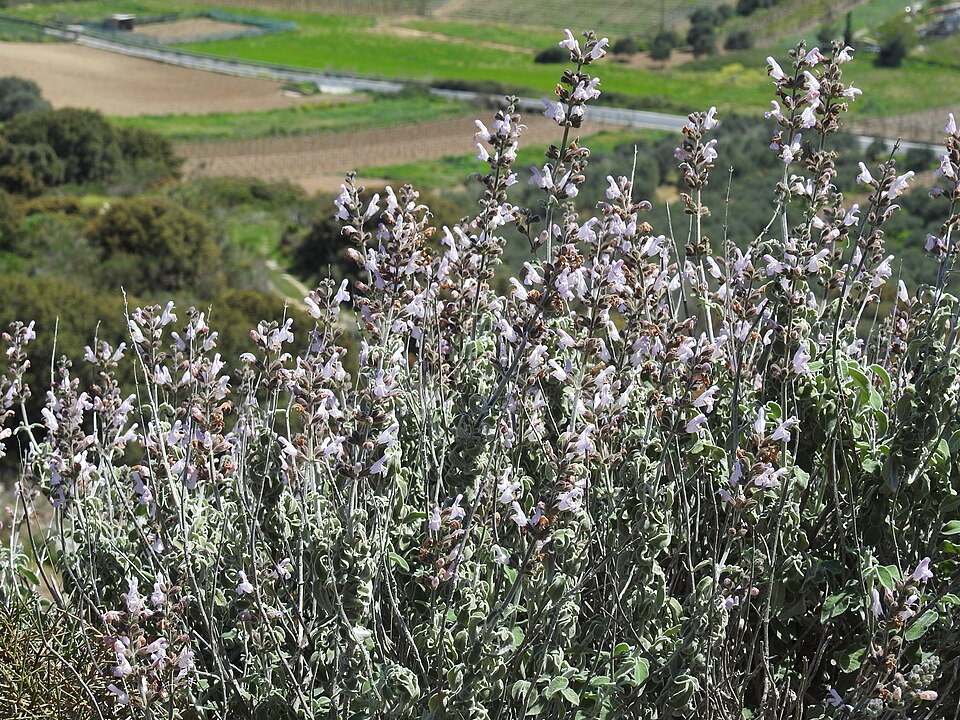
Photograph of Salvia fruticosa
Photo: Robert Flogaus-Faust · CC BY 4.0 · Wikimedia Commons (photo of Greek sage)
2050 · moderate emissions
Natural Earth (PD) · model output · ~10 km cells
Loading map layers (0 of 1)
Layers
Range keptLost by 2050Gained by 2050Cultivation zoneNatura 2000Occurrence cellCells ≈ 10 × 10 km

Occurrences are aggregated to ~10 km cells; exact points are never published. View range data as a table

De Materia Medica · Book III · ch. 33c. 50–70 CE
ἐλελίσφακον
elelisphakon
ἐλελίσφακον· οἱ δὲ ἐλαφοβόσκον, οἱ δὲ σφάγνον. θάμνος ἐστὶν ἐπιμήκης, πολύκλωνος, ῥάβδους τετραγώνους καὶ ὑπολεύκους ἔχων …
Modern identification
Salvia fruticosaMill. · LamiaceaeDisputed

Source: Sprengel 1830, vol. 2, p. 510; Fraas 1845, p. 184; Osbaldeston 2000.

Full citation and quoted evidence

Sprengel 1830, vol. 2, p. 510 (Comm. III cap. XXXV, ἐλελίσφακον): 'Quaenam salviae species intelligatur, potest omnino ambigi. Vero tamen est haud absimile, Salviam nostram officinalem, quae in asperis omnis Graeciae locis provenit, hac appellatione comprehendi.' Sprengel names Salvia officinalis (tentatively), NOT S. fruticosa; the species is explicitly said to be open to doubt. Fraas 1845, p. 184: '20. Salvia pomifera L., breitblättriger Salbey (triloba und baccifera sind synonym). Ist die bei weitem häufigste in Griechenland' = σφάκος Theophr., ἐλελίσφακον Diosc. 3,35; also S. calycina L. = ἐλελίσφακον Theophr.; S. officinalis 'Sehr selten!' in Greece. Fraas treats S. triloba (= S. fruticosa) as a synonym within his S. pomifera, so his identification covers S. fruticosa only in that lumped sense. Osbaldeston 2000, ch. 3-40 ELELISPHAKON: SUGGESTED Salvia maior, Salvia minor [Fuchs, Bauhin], Salvia officinalis [Linnaeus]. (https://archive.org/details/BIUSante_dioscsprengelx02/page/n511/mode/1up ; https://archive.org/details/synopsisplantaru00fraa/page/n229/mode/1up)

Opening words of the chapter (Wellmann numbering). Edition: Wellmann 1906, Pedanii Dioscuridis Anazarbei De materia medica vol. II (libri III-IV), Berlin: Weidmann; read from page scan on archive.org (BIUSante_65865x02), p. 44. See the page scan.

No European Medicines Agency herbal monograph for this species.

Projected range change by 2050

2050 · moderate (SSP2-4.5)+28% (+23 to +47%)
2050 · high (SSP5-8.5)+82% (+46 to +89%)

Median and spread across 3 climate models. Whisker axis −80% to +20%, dashed tick at 0; a chevron means the value runs beyond the axis.

Suitable cultivation area, 2050 moderate3,146 km² (2,181–4,720 km²)

Risk score breakdown

0.29 (0.29–0.29)Moderate risk class 2
00.51.0
  • Range loss 0.00 of max 0.40 · (0.00–0.00)
  • Endemism 0.00 of max 0.20 · not endemic
  • Conservation status 0.10 of max 0.20 · not assessed
  • Harvest pressure 0.19 of max 0.20

Stays in the top 10 in 0% of 1,000 random weightings.

How the score is built, and how sensitive it is to weights

Model quality

Standard grade
AUC (spatial block CV)
0.85 ± 0.02
Distance-only baseline AUC
0.78 ours is higher
Boyce index
0.93 ± 0.04
TSS
0.61 ± 0.05
Occurrence records
869 after cleaning (of 1,292)

5-fold spatial block cross-validation (~25 km blocks); ± is one standard deviation across folds. Null model AUC 0.51. The baseline scores each held-out point by its distance to the nearest training record, on the same folds. "Standard" grade means ≥ 30 records, AUC ≥ 0.75 and above the baseline; fewer than 10 records is a data gap; anything else is low grade.

Suggested action

Cultivation opportunity

Climate-resilient candidate crop; cultivation can take pressure off wild collection. Resolve the identification first.

Rule: Gains or keeps habitat · has a 2050 cultivation zone.

Where it could be grown

Identification through time

Who has matched ἐλελίσφακον to which modern plant, from the Renaissance to today.

All names through time
Cited for the identification we modelProposed an alternativeAlternative preferred by our sourceAlternative rejected by our sourceCommonly proposed, not verified by us
Renaissance commentators
Linnaean botany & Flora Graeca
Edition
Modern
150016001700180019002000
  • ἐλελίσφακονDMM 3.33 · Greek sageSalvia fruticosaDisputed

Select a mark to read who proposed which plant, and the source we read it in.

Dates are each authority's main herbal or commentary (approximate, "c."), used to order the timeline. Claims are parsed from our curated identification table; every quote links back to a page scan or edition on the plant page.

Caveats

  • Identification is disputed; results describe Salvia fruticosa Mill., which may not be the plant Dioscorides meant.

Range data (map alternative)

ScenarioSuitable ~10 km cellsChangeShare in Natura 2000
Now704—21.9%
2050 moderate886 (872–998)+28% (+23 to +47%)25% (24–25%)
2050 high1,210 (967–1,228)+82% (+46 to +89%)26% (25–26%)