Dioscorides' Plants, Then and Now
μάραθον

Fennel

Foeniculum vulgare Mill. · Apiaceae
Identification: CertainNot endemic to GreeceConservation status not assessedLow-confidence model
Risk rank
21 of 32 (17–23)
Risk score
0.29(0.29–0.29)2 · Moderate
Low-confidence modelFennel (Foeniculum vulgare) has 819 occurrence records after cleaning; we require 30 for a reliable model. Maps are exploratory outlines only, and its rank carries a wide interval (17–23).

Then and now

2050 · moderate emissions. SSP2-4.5, 2041-2060, 3 climate models; ranges show the spread.

The plant
μάραθον
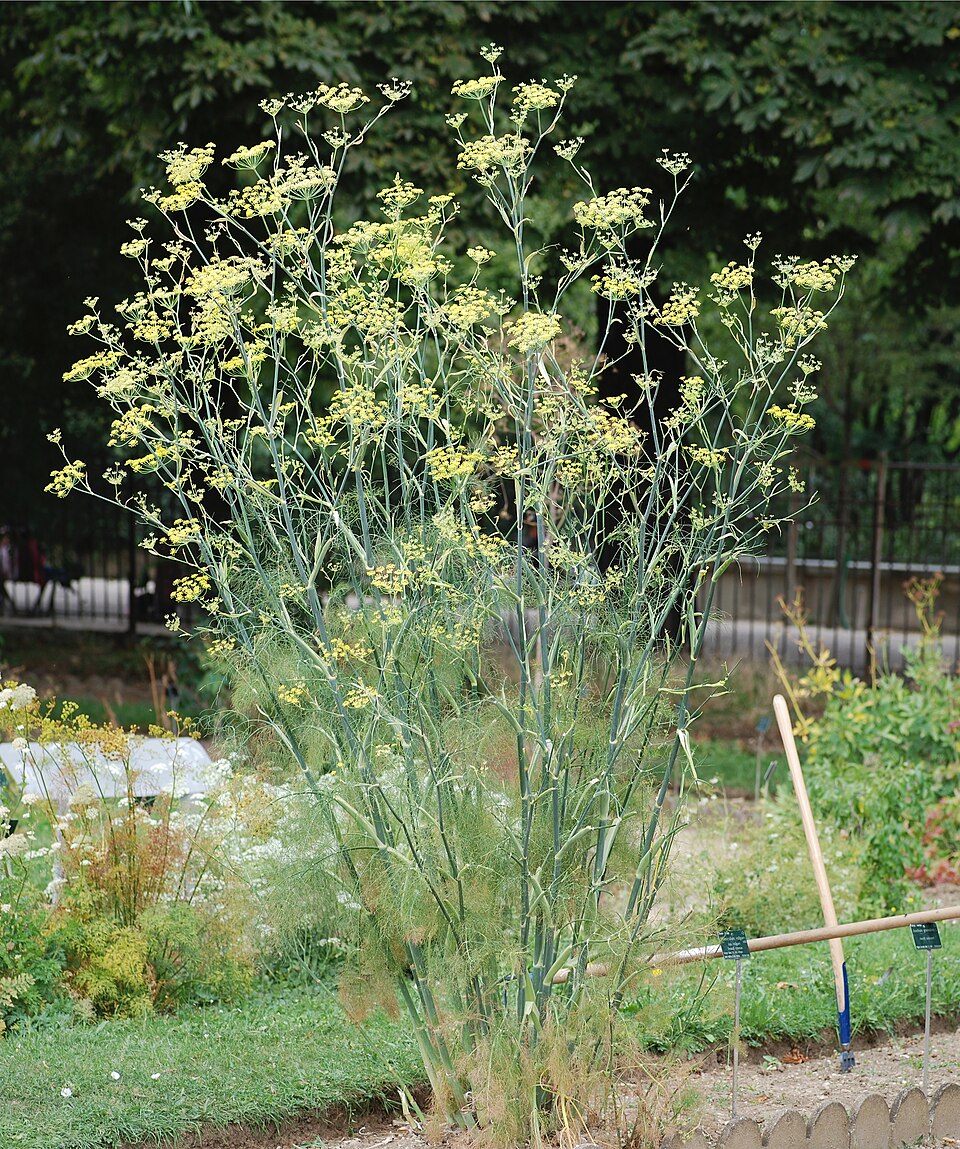
Photograph of Foeniculum vulgare
Photo: Alvesgaspar · CC BY-SA 3.0 · Wikimedia Commons (photo of Fennel)
2050 · moderate emissions
Natural Earth (PD) · model output · ~10 km cells
Loading map layers (0 of 1)
Layers
Range keptLost by 2050Gained by 2050Cultivation zoneNatura 2000Occurrence cellCells ≈ 10 × 10 km

Exploratory map (low-confidence model). Occurrences are aggregated to ~10 km cells; exact points are never published. View range data as a table

De Materia Medica · Book III · ch. 70c. 50–70 CE
μάραθον
marathon (MSS also marathron)
μάραθον· τούτου ἐσθιομένη ἡ πόα δύναται γάλα κατασπᾶν, καὶ τὸ σπέρμα δὲ πινόμενον ἢ συνεψόμενον πτισάνῃ. …
Modern identification
Foeniculum vulgareMill. · ApiaceaeCertain

Source: Wellmann 1906, vol. II p. 81.

Full citation and quoted evidence

Wellmann 1906, vol. II p. 81, III 70 RV synonym: Romans call it φενούκλουμ (feniculum); Sprengel, K. 1830. Pedanii Dioscoridis Anazarbei De materia medica libri quinque, tomus secundus (Commentarius in Dioscoridem), Medicorum Graecorum Opera vol. 26, Leipzig, Comm. lib. III cap. LXXIV, p. 524 (fennel; index: 'Meum Foeniculum Spr.')

Opening words of the chapter (Wellmann numbering). Edition: Wellmann 1906-1914 (vol. I 1907, vol. II 1906), Berlin: Weidmann; transcribed by eye from the archive.org page scan (Wellmann's ϑ glyph rendered as θ; no emendation). See the page scan.

Modern official status

European Medicines Agency herbal monograph

Foeniculi amari fructus; Foeniculi dulcis fructus; Foeniculi amari fructus aetheroleum · category: traditional

We report regulatory status only and make no claim about effects. Read the monograph for its exact wording.

Open the monograph on ema.europa.eu

Projected range change by 2050

2050 · moderate (SSP2-4.5)+76% (+61 to +79%)
2050 · high (SSP5-8.5)+98% (+76 to +100%)

Median and spread across 3 climate models. Whisker axis −80% to +20%, dashed tick at 0; a chevron means the value runs beyond the axis.

Suitable cultivation area, 2050 moderate0 km² (0–0 km²)

Risk score breakdown

0.29 (0.29–0.29)Moderate risk class 2
00.51.0
  • Range loss 0.00 of max 0.40 · (0.00–0.00)
  • Endemism 0.00 of max 0.20 · not endemic
  • Conservation status 0.10 of max 0.20 · not assessed
  • Harvest pressure 0.19 of max 0.20

Stays in the top 10 in 0% of 1,000 random weightings.

How the score is built, and how sensitive it is to weights

Model quality

Low grade
AUC (spatial block CV)
0.73 ± 0.02
Distance-only baseline AUC
0.65 ours is higher
Boyce index
0.89 ± 0.05
TSS
0.38 ± 0.03
Occurrence records
819 after cleaning (of 1,030)

5-fold spatial block cross-validation (~25 km blocks); ± is one standard deviation across folds. Null model AUC 0.49. The baseline scores each held-out point by its distance to the nearest training record, on the same folds. "Standard" grade means ≥ 30 records, AUC ≥ 0.75 and above the baseline; fewer than 10 records is a data gap; anything else is low grade.

Suggested action

Monitor

Stable or expanding; keep watching harvest and status. Resolve the data first.

Rule: Gains or keeps habitat · no 2050 cultivation zone.

See the action plan

Identification through time

Who has matched μάραθον to which modern plant, from the Renaissance to today.

All names through time
Cited for the identification we modelProposed an alternativeAlternative preferred by our sourceAlternative rejected by our sourceCommonly proposed, not verified by us
Renaissance commentators
Linnaean botany & Flora Graeca
Edition
Modern
150016001700180019002000
  • μάραθονDMM 3.70 · FennelFoeniculum vulgareCertain

Select a mark to read who proposed which plant, and the source we read it in.

Dates are each authority's main herbal or commentary (approximate, "c."), used to order the timeline. Claims are parsed from our curated identification table; every quote links back to a page scan or edition on the plant page.

Caveats

  • Low-confidence model: 819 thinned records (we require 30) or AUC below 0.75.

Range data (map alternative)

ScenarioSuitable ~10 km cellsChangeShare in Natura 2000
Now1045—20.8%
2050 moderate1,430 (1,318–1,454)+76% (+61 to +79%)23% (22–23%)
2050 high1,572 (1,415–1,582)+98% (+76 to +100%)23% (23–23%)