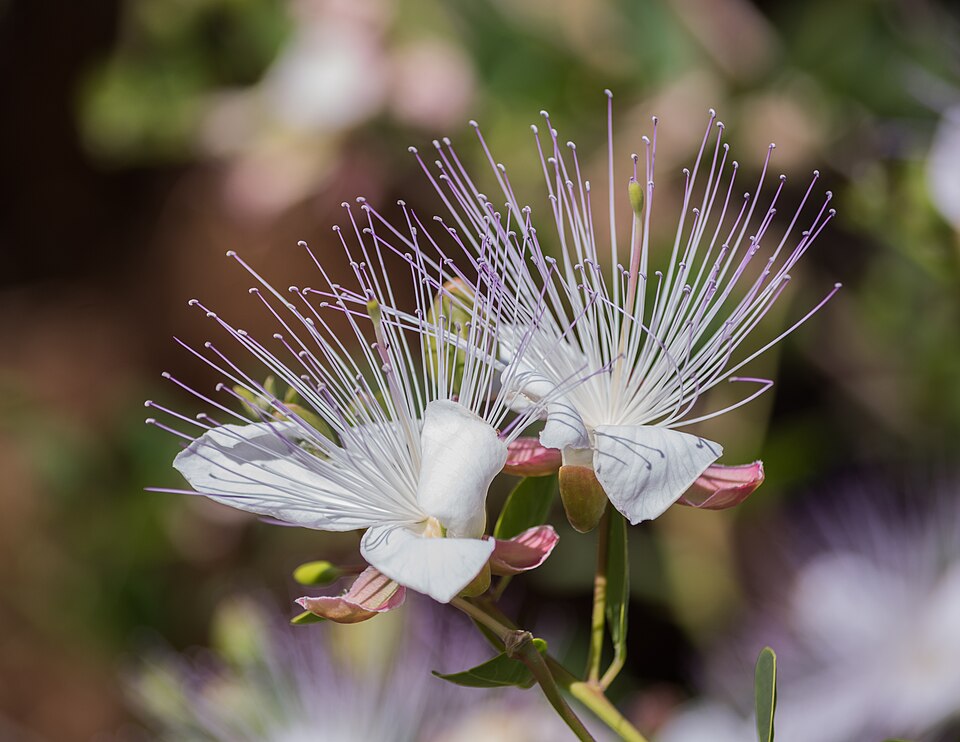

κάππαρις· οἱ δὲ κυνόσβατον, οἱ δὲ καπρίαν, οἱ δὲ κόρακος μῆλον, […] θάμνος ἐστὶν ἀκανθώδης, ἐπὶ γῆς γυροειδῶς ἐστρωμένος, ἀκάνθας ἀγκιστροειδεῖς ἔχων ὡς βάτος …Greek capers are split into C. orientalis, C. sicula and C. zoharyi in the Greek checklist; GBIF keeps C. orientalis separate, so its records are pooled with C. spinosa s.l. Source: Sprengel 1830, vol. 2, p. 483; Fraas 1845, p. 116; Osbaldeston 2000.
Full citation and quoted evidence
Sprengel 1830, vol. 2, p. 483 (Comm. II cap. CCIV): discusses names; 'Ceterum descriptio optima'; the very acrid caper from the Red Sea coast and Africa = perhaps Forsskål's Capparis redif s. oblongifolia. The species name for the main plant is given only in Index V, p. 702: 'Capparis spinosa L. 483' (and 'Capparis oblongifolia Forsk. 483'). Sprengel does not distinguish C. spinosa from C. orientalis (Linnaean C. spinosa s.l.). Fraas 1845, p. 116: '1. Capparis spinosa L. var. ovata W., rundblättrige, gemeine Kapper' = κάππαρις Theophr., κάππαρις Diosc. 2,204 'der noch einige andere ausländische Arten anführt'; very common in plains, among stones and on rocks (C. rupestris on sea cliffs), Attica, Boeotia, Corinth, Argos; 'folia ovalia apice mucronulato - retusa'. Osbaldeston 2000, ch. 2-204 KAPPARIS: SUGGESTED Capparis spinosa. Confidence raised to 'certain' for C. spinosa L. in the broad (pre-segregate) sense; no source opened distinguishes C. spinosa s.str. from C. orientalis (Fraas' 'var. ovata' and 'C. rupestris' are not mapped to modern names here). (https://archive.org/details/BIUSante_dioscsprengelx02/page/n484/mode/1up ; https://archive.org/details/synopsisplantaru00fraa/page/n161/mode/1up)
Opening words of the chapter (Wellmann numbering). Edition: Wellmann, Pedanii Dioscuridis Anazarbei De materia medica, vol. I (Berlin 1907), p. 240; read off the archive.org page image (item b21459162_0001; the OCR of this volume is not usable Greek); ϑ printed as θ. See the page scan.